Recipient of a 2026 Whiting Award in Poetry
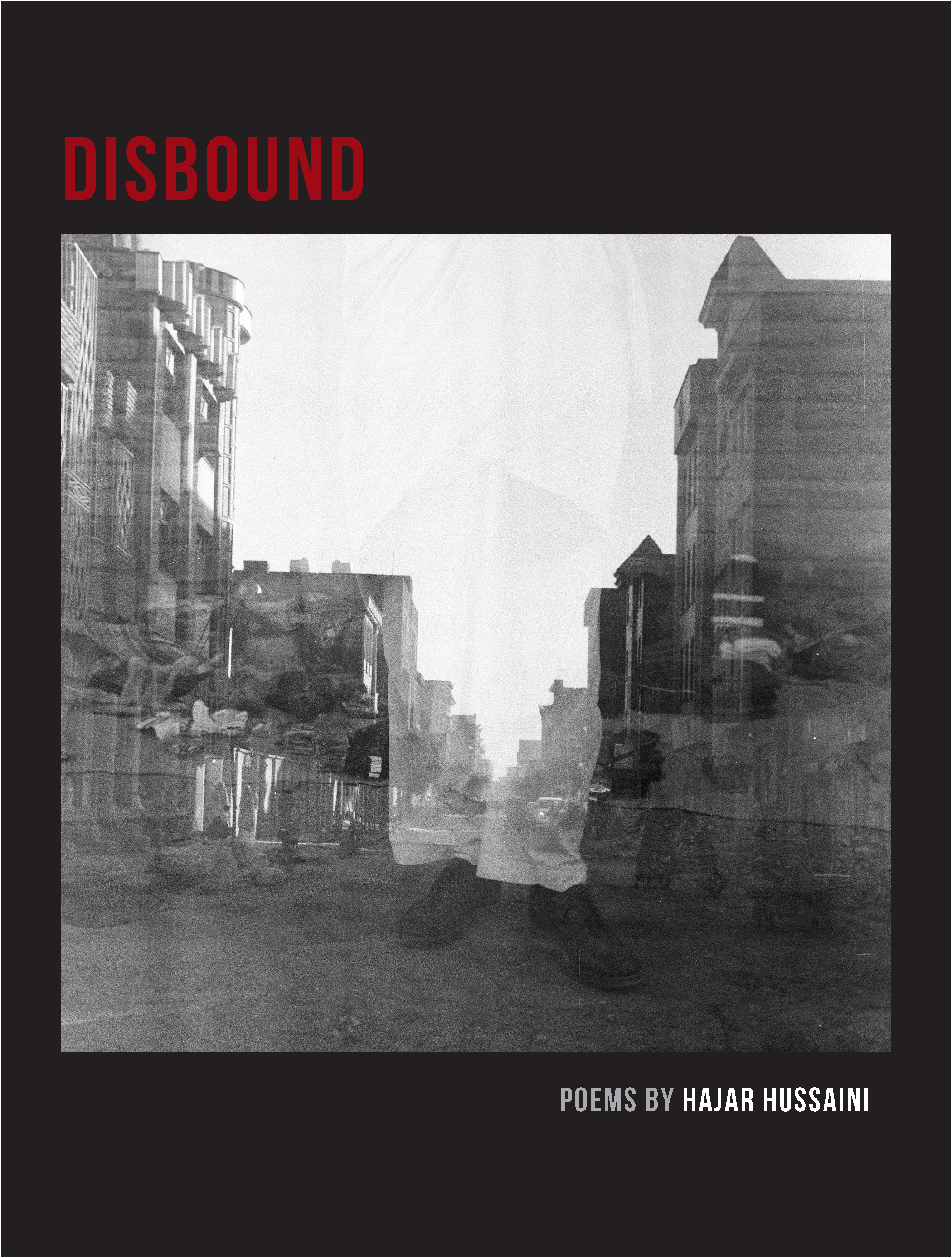
“Hajar Hussaini’s work is a marvel of poetic architecture, one that propels readers to consider what war destroys and what remains. Her poems exemplify how mere fragments can contain the entirety of times, places, and people we thought lost. Defiant, they refuse to equate that loss with erasure. Hussaini assembles the shards of her home city of Kabul into a mosaic, honoring its history, culture, and future.”
– The Whiting Award Judges’ Citation
Order:
Read excerpts from Disbound
“Notes from Kabul” and “Sufis Instead.” Excerpt published on Whiting Foundation, www.whiting.org/awards/winners/hajar-hussaini.
“Disbound.” Dædalus, Spring 2023, American Academy of Arts and Sciences, www.amacad.org/publication/daedalus/disbound.
“meta-variable.” Poetry, Apr. 2022, www.poetryfoundation.org/poetrymagazine/poems/157541/meta-variable.
“proctoring.” The Margins, Asian American Writers’ Workshop, 22 Mar. 2022, aaww.org/proctoring/.
“the property of being separate,” “the parenthetical is (internal),” and “inverse of most stories.” Pamenar Press, 3 Nov. 2021, www.pamenarpress.com/post/hajar-hussaini.
“the photography of home,” and “road trip.” Pocket Samovar, issue 1, www.pocketsamovar.com/new-page-55.
“A Distinctive Duplication” and “the united nations of poetry rejects the full stop.” AZURE: A Journal of Literary Thought, www.lazuliliterarygroup.com/a-series-of-punctuation-by-hajar-hussaini.html
“Hussaini’s debut collection is radical in the fullest sense of the word: deeply rooted, innovative, truth-telling. Fiercely attentive to the complex bonds and disbindings of personhood, family, and nation, these poems also delight in art’s capacity to make a world—a parallel site of desire and belonging—without turning away from the realities of all that is coming apart around it. This is work of lasting imaginative power.”
— Elizabeth Willis, author, Address
“Hussaini's Disbound begins with what has fallen apart amid war and migration, shaping its poetics into a powerful interrogation of what persists, what brings shame, what we refuse to look at, what's left behind, and what never comes back. What is most striking about this brilliant first book is how it develops a vocabulary and syntax of the many types of violences produced by the failures of conquest and empire.”
— Daniel Borzutzky, author, Lake Michigan
“In Disbound, Hussaini builds an enduring monument out of war’s remnants. The poet unflinchingly takes up the exile’s task of taking inventory. Past and present, inner and outer, loss and longing meet on the page to trace a personal history against a nation’s history of unrelenting war. In language that is at once precise and haunting, Hussaini creates exquisite order out of disorder.”
— Fowzia Karimi, author, Above Us the Milky Way
“Hussaini frames her book in a fragile position: the ruin of the material text is incipient within its reader’s hands. Her opening placement of a formal Oxford definition is disturbed by poems that twist and distort traditional means of punctuation and syntax, inverting the neocolonial structures built into textual English.”
— from John Bosworth’s Review for Jacket 2
“Hussaini’s Disbound is a penetrating collection of poems that quietly magnify, with cerebral discernment, the left-behind world of home in Kabul as war and the quotidian continue. These poems awaken our memory to a careful present tense of pith description. The heart-kept is distilled in both deftly turning lyrics and deeply experimental fragments. Her innovative language shakes us with its brilliance and guides us into the reality of these arresting poems.”
— Prageeta Sharma, author, Grief Sequence
“What is most striking about these poems is how clearly they convey the loss inherent to the adoption of the English language. The full stop is “a ruthless authoritarian,” ellipses are a “cut tongue.” With this fierce attempt at bringing language to life, Hussaini also conveys the limits of true communication.”
—from Jeevika Verma’s Review for Kajal Magazine
Other Writings
-
-
“In Company Cannot Fathom Relation,” “Revenue,” and “Child Guest”. Cleveland Review of Books
-