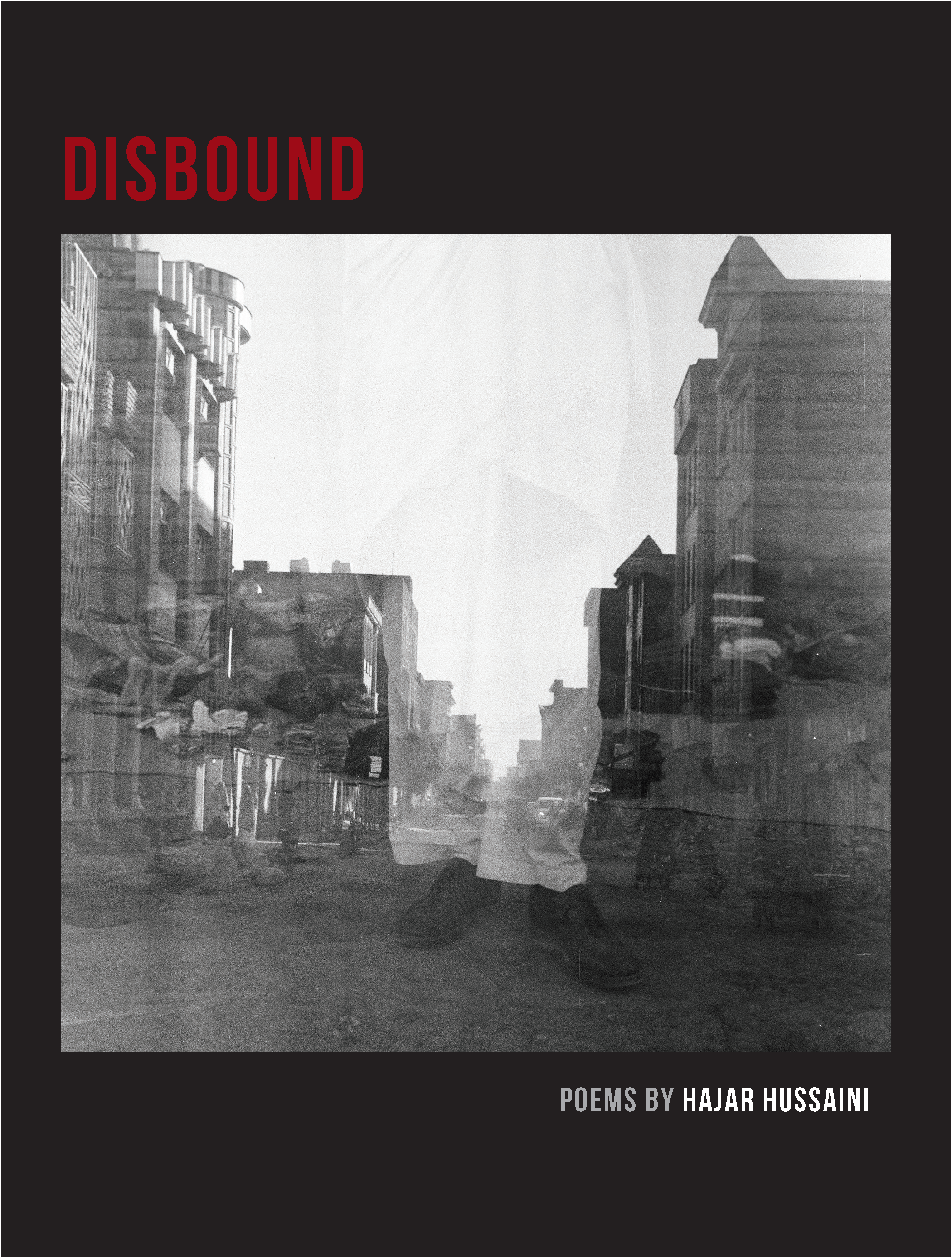
Disbound: Poems
Kuhl House Poets, edited by Mark Levine and Emily Wilson
University of Iowa Press, 2022
Reviews:
Jacket2: “Secure that delicate passage” by John Bosworth
Kajal Magazine: “‘Disbound’ Is a Poetic Monument To Abandonment” by Jeevika Verma
Hajar Hussaini’s poems in Disbound scrutinize the social, political, and historical traces inherited from one’s language. The traces she finds—the flow of international commodities implied in a plosive consonant, an image of the world’s nations convening to reject the full stop—retrieve a personal history between countries (Afghanistan and the United States) and languages (Persian and English) that has been constantly disrupted and distorted by war, governments, and media. Hussaini sees the subjectivity emerging out of these traces as mirroring the governments to whom she has been subject, blurring the line between her identity and her legal identification. The poems of Disbound seek beauty and understanding in sadness and confusion, and find the chance for love in displacement, even as the space for reconciliation in politics and thought seems to get narrower.
“Hussaini’s debut collection is radical in the fullest sense of the word: deeply rooted, innovative, truth-telling. Fiercely attentive to the complex bonds and disbindings of personhood, family, and nation, these poems also delight in art’s capacity to make a world—a parallel site of desire and belonging—without turning away from the realities of all that is coming apart around it. This is work of lasting imaginative power.”—Elizabeth Willis, author, Address
“In Disbound, Hussaini builds an enduring monument out of war’s remnants. The poet unflinchingly takes up the exile’s task of taking inventory. Past and present, inner and outer, loss and longing meet on the page to trace a personal history against a nation’s history of unrelenting war. In language that is at once precise and haunting, Hussaini creates exquisite order out of disorder.”—Fowzia Karimi, author, Above Us the Milky Way
“Hussaini’s Disbound is a penetrating collection of poems that quietly magnify, with cerebral discernment, the left-behind world of home in Kabul as war and the quotidian continue. These poems awaken our memory to a careful present tense of pith description. The heart-kept is distilled in both deftly turning lyrics and deeply experimental fragments. Her innovative language shakes us with its brilliance and guides us into the reality of these arresting poems.”—Prageeta Sharma, author, Grief Sequence
“Hussaini's Disbound begins with what has fallen apart amid war and migration, shaping its poetics into a powerful interrogation of what persists, what brings shame, what we refuse to look at, what's left behind, and what never comes back. What is most striking about this brilliant first book is how it develops a vocabulary and syntax of the many types of violences produced by the failures of conquest and empire.”—Daniel Borzutzky, author, Lake Michigan
Read selected poems from this collection:
Online Journals ««»» Dædalus: Disbound / POETRY: meta-variable / The Margins: proctoring / Pamenar Press Online: the property of being separate, the parenthetical is (internal), and inverse of most stories / Pocket Samovar: the photography of home and road trip / Azure: a distinctive duplication and the united nations of poetry rejects the full stop
Print Journals ««»» Atlanta Review: Tea House
Winner of a 2024 Mo Habib Translation Prize in Persian Literature
The Judges’ Citation:
The poetry of Maral Taheri is provocative and disquieting—in the very best of ways. It inspires surrender, then kaleidoscopically enthralls. There is an undeniable urgency to Taheri’s poetic voice, her truths, and the way she tells them, with uncanny juxtapositions of love, sex, scripture, war, and other kinds of violence. Her translator, Hajar Hussaini, describes her work—unpublishable both in Iran and Afghanistan—as raw, ‘defiantly feminine’, and piercingly intelligent. Hussaini’s remarkable translations echo these qualities. They also betray a deep kinship with their poet, an intimate, almost intrinsic, familiarity with her experience and expression. In Hussaini’s agile renderings, Taheri’s verses cascade down the page, each one building upon, breaking down, and bounding off the last. The rhythm continues to reverberate long after you stop reading. The effect is nothing short of tremendous.
Wounded Vita Nuda: Poems
by Maral Taheri
Translated from Persian By Hajar Hussaini
Deep Vellum, 2027
Read selected poems from this collection:
Online Journals ««»» Poem-a-Day: Asylum Seeker / Annulet: My Beige Bra and Third-World Beloved
Print Journals ««»» Two Lines’ Calico Issue, Hair on Fire: Afghan Women Poets: And the poem could have been a wound that never opens to ooze, Cybersex in the Face of My Father’s Death, and Embrace me
Winner of a 2025 PEN/Heim Translation Fund Grant
Honorable Mention for the 2023 Mo Habib Translation Prize in Persian Literature
The PEN/Heim Judges’ Citation:
Hajar Hussaini’s translation of Khosraw Mani’s 2017 Farsi-language novel Death and his Brother could not come at a more important time, as freedoms continue to be rolled back in Afghanistan by the Taliban, and not just for women. Neither this book nor any of Khosraw Mani’s five other novels have been translated into English, which makes Hussaini’s translation even more welcome. The novel depicts a single day in the lives of a few ordinary Kabul inhabitants. It starts off with a young man quietly sitting in a café in the Afghan capital; when a missile hits a house and kills four people, the reader sees how their worlds interconnect and how life can sometimes be deadlier than death itself. Told from multiple perspectives, this tragic story becomes one extended wail reminiscent of a Greek chorus. Experimental and daring, this is a book that everyone will enjoy, regardless of age or background. And rarely of late have we had a text from Persian so skillfully translated and which conveys the beauty of the original text in English. An important voice from a part of the world that Americans know very little about, apart from State Department-released stereotypes and racist tropes.
Death and His Brother: A Novel
by Khosraw Mani
Translated from Persian by Hajar Hussaini
Syracuse University Press, 2027
Middle Eastern Literature in Translation Series
Read selected poems from this collection:
Print Journals ««»» Copper Nickel: An excerpt for the Translation Folio
Other Writings and Translations:
Segment of a Book ««»» Rumi Roaming: “Look at the Moon,” Rumi Roaming: Contemporary Engagements and Interventions, curated and edited by Gita Hashemi.
Online Journals ««»» Cleveland Review of Books: In Company Cannot Fathom Relation, Revenue, and Child Guest / Asymptote: After My Own Death by Asef Hossaini, translated from Persian / The Los Angeles Review: this isn’t some small incident and winter by Mariam Meetra, translated from Persian.